
While the FPI limit on most bond issues would not be raised above 6 per cent, there would be some in which there would be no limits, reports Arup Roychoudhury.

For existing investors, it may be prudent to redeem their current investments in gilt or dynamic schemes and invest it in short-term funds, if the exit load is not very high, advises Malhar Majumder.

A negative oil shock, together with rising government-bond yields, could clip the recovery's wings, says Nouriel Roubini.
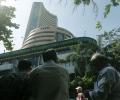
BSE benchmark Sensex plummeted over 388 points to close at 58,576.37 on Tuesday, tracking weakness in index majors Wipro, RIL and Bharti Airtel amid a weak trend in global markets. Investors also remained cautious ahead of crucial macroeconomic data announcements -- industrial production for February and inflation rate for March -- post trading hours. The Sensex declined 388.20 points or 0.66 per cent to settle at 58,576.37. During the day, the benchmark tanked 666 points or 1.12 per cent to 58,298.57.

Novice investors must understand that volatility is an inherent part of equity markets and learn to navigate through such phases.

Among top losers that dragged down key indices were Infosys, TCS, Reliance, SBI, Tata Steel and ITC, falling up to 2.15 per cent.

The rating outlook change is relevant now, as the US Federal Reserve is set to end its monthly bond-buying programme in October.

Continuing their massive selling spree for the ninth consecutive month, foreign investors dumped Indian shares worth Rs 50,203 crore in June -- the highest net outflow in over two years -- amid aggressive rate hike by the US Federal Reserve, elevated inflation and relatively higher valuation of domestic equities. Foreign portfolio investors (FPIs) have now pulled out around Rs 2.2 lakh crore from domestic equities in the first six months of 2022 -- the highest-ever net withdrawal by them. Before that, FPIs withdrew Rs 52,987 crore in the entire 2008, data with depositories showed.

The RBI interest rate decision, industrial production data for June and the ongoing quarterly earnings from corporates would largely drive the stock markets this week, analysts said. Other major factors such as global market trends, the movement of oil prices and the trading activity of foreign investors would also influence trading, they added. "The market will have an eye on the RBI Monetary Policy Committee (MPC) meeting, which will be announced on August 10, 2023. We are heading towards the last batch of Q2 earnings of key companies such as Adani Ports, Coal India, Hero MotoCorp, Hindalco and ONGC, among others, which will lead to stock-specific movement," said Pravesh Gour, senior technical analyst, Swastika Investmart Ltd.

Among the Sensex firms, State Bank of India, Infosys, Titan, Tech Mahindra, IndusInd Bank, NTPC, ICICI Bank, Power Grid, Reliance Industries and Kotak Mahindra Bank were the major laggards. On the other hand, Tata Motors, Nestle, Hindustan Unilever, Tata Steel, Bajaj Finance and UltraTech Cement were among the gainers.
Equity market will be guided by global trends, macroeconomic data announcement and foreign fund movement in a holiday-shortened week ahead, analysts said. Movement of the rupee and Brent crude oil will also remain in focus this week, they added. "The bulls need some support from global markets to continue Friday's momentum.

Dr Reddy's was the top loser in the Sensex pack, shedding around 5 per cent, followed by M&M, Tech Mahindra, Axis Bank, IndusInd Bank and TCS. NSE Nifty sank 306.05 points to finish at 14,675.70.
Equity markets will be driven by the outcome of the US Federal Reserve's interest rate decision this week, analysts said. Moreover, equity benchmarks will also continue to be guided by foreign fund movement and trend in Brent crude oil, they added. "The global markets are looking nervous after the US inflation numbers, which have caused the dollar index to hover around 110," said Santosh Meena, head of research, Swastika Investmart Ltd. Now everyone is eyeing the outcome of the upcoming US Federal Open Market Committee (FOMC) meeting.

It's the first time in my memory that I have seen a negative expected return for equities, notes Akash Prakash. Hopefully, this implies the consensus is being too negative, and markets, as usual, will surprise everyone and deliver the least likely outcome.

The NSE Nifty settled at 10,454.95, down 121.90 points, or 1.15 per cent.

'As the growth momentum reverses benefiting from re-monetisation, it will be accompanied by a rise in inflation.'

Amid slowing growth and low interest rates, investors will need to focus on stock-picking, suggests John Remmert.

The Cabinet meeting and the holy dip comes on a day that marks the first anniversary of the consecration ceremony of the Ram temple in Ayodhya.

Among major Sensex shares, PowerGrid fell the most by 2.76 per cent. IndusInd Bank dropped 2.34 per cent, HUL by 2.23 per cent and NTPC by 2.04 per cent. ICICI Bank, HDFC Bank, HDFC, ITC, Infosys, L&T, Bajaj Finance, Kotak Bank, HCL Tech and Tech Mahindra were among the losers. On the other hand, Tata Motors rose the most by 2.94 per cent, followed by Titan which gained 1.26 per cent. Mahindra & Mahindra, SBI and TCS were also among gainers.

Bharti Airtel was the top loser in the Sensex pack, shedding nearly 4 per cent, followed by Tech Mahindra, Bajaj Finance, Bajaj Finserv, HCL Tech and Infosys.

The rupee is expected to remain volatile in the new financial year.

In February, FPIs sold $421 mn in debt; in March they have sold $133 mn so far

The S&P BSE Midcap and the S&P BSE Smallcap indices have managed to stay afloat in a volatile January that saw the frontline indices hit their respective 52-week high levels and then slip. While the S&P BSE Sensex has lost over 2 per cent thus far in January, the S&P BSE Midcap and the S&P BSE Smallcap indices have gained nearly 2.5 per cent and 4 per cent, respectively during this period.
Stock markets would be largely driven by macroeconomic data, auto sales numbers, FII inflows and global trends this week, analysts said. The US debt ceiling negotiations and institutional flows will also be watched by investors. "This week, market participants will closely monitor institutional flows, as there is a historical observation that when both FIIs and DIIs become net buyers simultaneously, there is a likelihood of some profit-booking in the market," said Santosh Meena, head of research, Swastika Investmart Ltd.

'Rising Covid cases and localised lockdowns are being closely monitored.'

If Chinese growth starts falling, sharply or otherwise, the risk on trade might reverse.

Debt mutual fund (MF) schemes, which witnessed relatively muted inflows in the past three years, saw a surge in investor interest in April amid election-induced volatility in the equity markets. Active debt funds garnered nearly Rs 66,000 crore net inflows in April, most at least since December 2020.

Trading in the equity market this week will be highly influenced by a host of important triggers, with quarterly earnings from IT majors TCS, Wipro, and domestic inflation and IIP data taking the centre stage in dictating the movement in equities, analysts said. Besides, global factors and trading activity of foreign investors will also drive markets. "We are approaching the first quarter earnings season, with HCL Tech, TCS and Wipro set to report their earnings this week.

Stock markets this week would take cues from global trends, the announcement of domestic macroeconomic data such as GDP numbers and foreign fund movement, analysts said. Besides, monthly auto sales and Purchasing Managers' Index (PMI) data for manufacturing and services sectors would also influence trading in the market, they added. Benchmark BSE Sensex tumbled 1,538.64 points or 2.52 per cent last week amid concerns that the US Federal Reserve might raise interest rates further to curb inflation.

Select the exact category by matching your investment horizon to the portfolio duration, suggests Sanjay Kumar Singh.

The domestic equity market, which is on a record-breaking spree, will focus on macroeconomic data announcements, movement in global stocks and the US Fed minutes to get further direction, analysts said. Trading activity of Foreign Institutional Investors (FIIs) will also innfluence investors.From the domestic macroeconomic front, Purchasing Managers' Index (PMI) data for the manufacturing sector will be released on Monday, and that o,f the services sector on Wednesday. Investors, this week, will keenly watch major global market events, icluding the outcome of the Federal Open Market Committee (FOMC) minutes, scheduled to be out on Wednesday.

'India represents one of the top opportunities with robust growth, solid fundamentals, and openness to foreign investment.'

Investors' wealth has tumbled by over Rs 5.82 lakh crore in three days of market decline. Feeble global cues, foreign fund outflows and concerns over policy tightening by central banks have led to the selling pressure, experts said. Declining for the third straight session on Monday, the 30-share BSE benchmark Sensex nosedived 1,023.63 points or 1.75 per cent to close at 57,621.19. In three days, the benchmark has tanked 1,937.14 points.
Domestic stock markets would be driven by inflation numbers, global trends, and the last batch of Q4 earnings this week, analysts said. Markets will also react to industrial production data and consumer inflation numbers that were released after market hours on Friday. "Participants will react to macroeconomic data viz. IIP and CPI first, which were released post-market hours on Friday.

From the Sensex pack, Larsen & Toubro jumped 4.26 per cent to emerge as the biggest gainer, followed by IndusInd Bank, Tech Mahindra, State Bank of India, HCL Technologies, Power Grid, NTPC, Axis Bank, Kotak Mahindra Bank, HDFC Bank and Wipro. Mahindra & Mahindra, Infosys, UltraTech Cement and Hindustan Unilever were the major laggards.

'Data-dependence means you can raise or drop rates. The present stance is only for raising rates.'

Notwithstanding concerns about lofty valuations, smallcaps recorded their most significant monthly gain in nearly three years in November. The National Stock Exchange Nifty Smallcap 100 finished the month with a 12 per cent gain, the most since February 2021 when it rose by 12.2 per cent. After declining by 4.1 per cent in the preceding month, the Nifty Midcap 100 rose by 10.4 per cent, the most since July 2022.

Bajaj Finance was the top loser in the Sensex pack, shedding around 3 per cent, followed by Bajaj Finserv, Reliance Industries, M&M, Nestle India and SBI. On the other hand, Axis Bank, Tech Mahindra, PowerGrid and Maruti were among the gainers.

After two years of a record low interest-rate regime, Indian corporate houses are experiencing a sharp and abrupt increase in funding costs. With the Reserve Bank of India last month making an unequivocal turn towards policy tightening amid high inflation, firms looking to tap the capital markets for funds are ending up shelling out more. The yield on the benchmark triple-A-rated corporate bonds maturing in three years has climbed 98 basis points (bps) since the policy rate hike in May. It was last at 7.47 per cent, Bloomberg data showed.

IndusInd Bank was the top loser in the Sensex pack, shedding over 3 per cent, followed by HUL, ONGC, ICICI Bank, Axis Bank, Kotak Bank, M&M and Tech Mahindra. NSE Nifty tumbled 154.25 points to 14,696.50.
